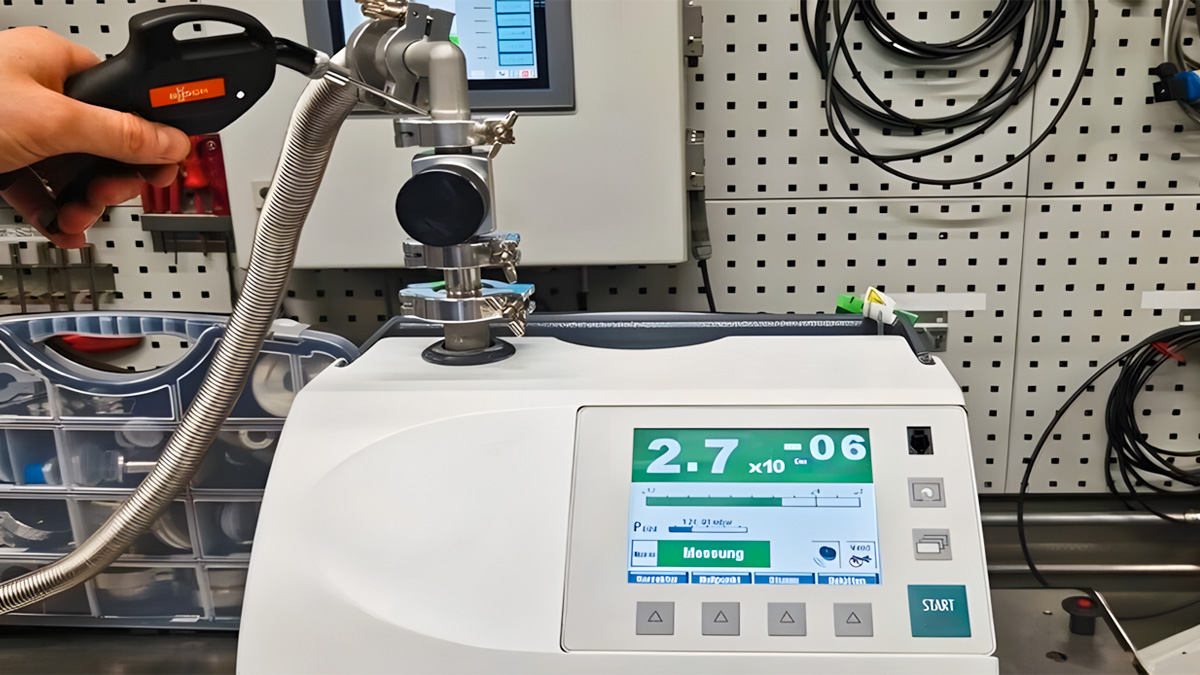
MAULBURG, GERMANY, September 28, 2026 /EINPresswire.com/ — One of the most common but most underestimated causes of inefficiency in vacuum systems is leakage. Leaks may seem like a minor issue, particularly if the system still reaches the required pressure. However, the energy wasted by even a small leak can be significant. Additionally, leaks can reduce process reliability, quality, and productivity, making their prevention essential for maintaining efficiency.
Why leaks reduce efficiency
Leaks force vacuum pumps to work harder to maintain the desired vacuum level as they must cope with additional gas load. Vacuum pumps move volumes of gas at low pressure, so air leaking in increases the volumetric flow rate that a vacuum pump must handle, resulting in greater energy demand. The lower the operating pressure of a vacuum system, the more sensitive it becomes to small leaks, which can have a significant impact on efficiency. At lower pressures, the difference between the system pressure and atmospheric pressure becomes greater, causing any air that enters through a leak to expand dramatically, meaning even tiny leaks can introduce large volumes of gas into the system.
The true cost of vacuum leaks
In a typical food vacuum packaging process operating at 5 hPa (mbar), a hole just 1 mm in diameter allows around 400 m³/h of air to enter the vacuum system. That is the equivalent of running an 11 kW vacuum pump constantly, simply to counteract the leak. None of this energy contributes to your process; it is simply waste that inflates your energy bill and environmental footprint.
In processes where pressure stability and uptime are critical, pressure fluctuations can result in lost productivity, quality issues, or even scrap. This is also the case in processes that require deep vacuum levels. In such processes, even small fluctuations in pressure can cause instability, longer cycle times, or inconsistent results. Over time, the extra workload that leaks place on vacuum pumps can accelerate wear, leading to more frequent maintenance and a reduced lifespan.
Common sources of vacuum leaks
Leaks can develop in many areas of a vacuum system, but some locations are more vulnerable than others.
• Valves may leak if seals are worn or contaminated.
• Pipework joints, such as flanges or threaded fittings, can degrade over years of vibration or stress, particularly in cases of poor installation.
• Seals, gaskets, and O-rings naturally age and may crack or harden, especially under heat or chemical exposure.
• Flexible hoses often suffer from cracks or pinholes due to repeated flexing or abrasion.
• Instrumentation ports can be an overlooked source of leakage if left unused or improperly sealed.
Being aware of these common leak points makes it easier to build regular inspections into your maintenance program and address potential issues before they escalate.
How to detect vacuum leaks
Early detection is essential to prevent energy from being wasted. Three of the most effective methods are helium leak testing, ultrasonic detection, and vacuum decay testing
• Helium leak testing: Helium molecules pass easily through micro-leaks, and detectors can identify even extremely small leaks with accuracy. This
makes the method ideal for applications requiring high vacuum integrity, such as processes operating below 1 hPa (mbar).
• Ultrasonic leak detection: As air rushes into a vacuum system, it generates high-frequency sound waves. These cannot be heard by humans but are
easily picked up by the sensors on ultrasonic leak detector equipment. This method is quick and reliable for routine maintenance checks and is
recommended for rough vacuum conditions (from atmospheric pressure down to ~1 hPa or ~1 mbar), with a minimum detectable leak diameter of
approximately 30 µm.
• Vacuum decay (pressure rise) testing: One of the most effective methods for detecting leaks in a vacuum system is monitoring how pressure changes
once the system is isolated. With the vacuum pumps switched off and sealed from the process, the rate of pressure rise can be measured. This data can
then be used to calculate the size of a leak. While this technique does not pinpoint the exact leak location, it provides reliable data on system integrity.
By isolating and testing different sections individually, you can narrow down the search area and identify where further investigation is needed.
How to prevent leaks
While leak detection is important, prevention should always be the first line of defense. Good practices include:
• Correct installation: Proper assembly of pipework joints and fittings is essential to maintain vacuum integrity. Joints should be aligned accurately and
tightened securely but never forced into place. Misalignment or stressed fittings may not leak straight away but can lead to leaks developing over time.
Supporting the pipework correctly also avoids excess strain on joints and helps to prevent leaks from occurring.
• Use suitable pipework joint types: The choice of joint has a direct impact on leak tightness. Options include threaded connections, gasket-sealed and
O-ring sealed flanges. While threaded joints are common in vacuum systems operating at higher pressures, they are also more prone to leaks. The
threads themselves provide multiple potential leak paths. In addition, vibration or thermal expansion can cause threaded fittings to loosen slightly. To
improve leak tightness, care should be taken to apply an appropriate sealant to the threads during assembly. For medium and high vacuum
installations, O-ring-sealed joints provide a far superior seal, ensuring greater leak resistance. This is because the elastomer O-ring deforms to fill
surface imperfections on the sealing faces, maintaining a tight, flexible seal even under pressure or temperature fluctuations. Gasket seals are
preferred for static flange joints when O-rings reach their limits, especially at higher temperatures, with aggressive media, or where low outgassing is
required. Soft gaskets such as PTFE (polytetrafluoroethylene) or graphite are suitable for rough to medium vacuum, while metal gaskets such as
oxygen-free high-conductivity (OFHC) copper are the standard for bakeable high vacuum and ultra-high-vacuum systems.
• Select the right materials: The durability of a vacuum system depends heavily on material compatibility. Seals, gaskets, and hoses must be matched to
the process conditions, including temperature, chemical exposure, and pressure levels. Using the wrong material can cause swelling or cracking,
accelerate wear, and lead to leaks. By specifying high-quality, process-compatible materials, you extend component life and protect the integrity of
your vacuum system. For example, NBR (nitrile butadiene rubber) is often a common material choice for O-rings, but harsh process conditions may
require an elastomer which has a greater resistance to attack by chemicals present in the process, such as FKM (fluoroelastomer).
• Keep sealing surfaces clean: Even small amounts of dirt, dust, or residue can prevent a proper seal and compromise vacuum integrity. During
installation or maintenance, ensure that all sealing surfaces are free from contaminants before assembly. Clean surfaces provide tighter, more reliable
seals, reducing the risk of energy loss and unplanned downtime caused by leaks.
• Regular inspection and maintenance: Over time, seals, hoses, and gaskets naturally degrade due to wear, heat, or chemical exposure. A proactive
inspection schedule allows you to identify and replace these components before they fail. Preventive maintenance such as this not only avoids costly
leaks but also helps to prevent unplanned downtime caused by breakdowns.
• Isolate unused equipment: Every additional connection in a vacuum system is a potential leak path. By installing isolation valves and keeping them
closed when equipment is not in use, you can significantly reduce the chance of leakage.
Summary: improving vacuum pump efficiency by reducing leaks
Addressing vacuum leaks is one of the most cost-effective steps to improve vacuum system efficiency. By making leak prevention and detection part of your regular maintenance program, you not only reduce operating costs but also enhance the reliability and sustainability of your operations.
Dr Sandra Thirtle-Höck
Busch Group
+49 6441 8021460
email us here
Legal Disclaimer:
EIN Presswire provides this news content “as is” without warranty of any kind. We do not accept any responsibility or liability
for the accuracy, content, images, videos, licenses, completeness, legality, or reliability of the information contained in this
article. If you have any complaints or copyright issues related to this article, kindly contact the author above.

Media gallery