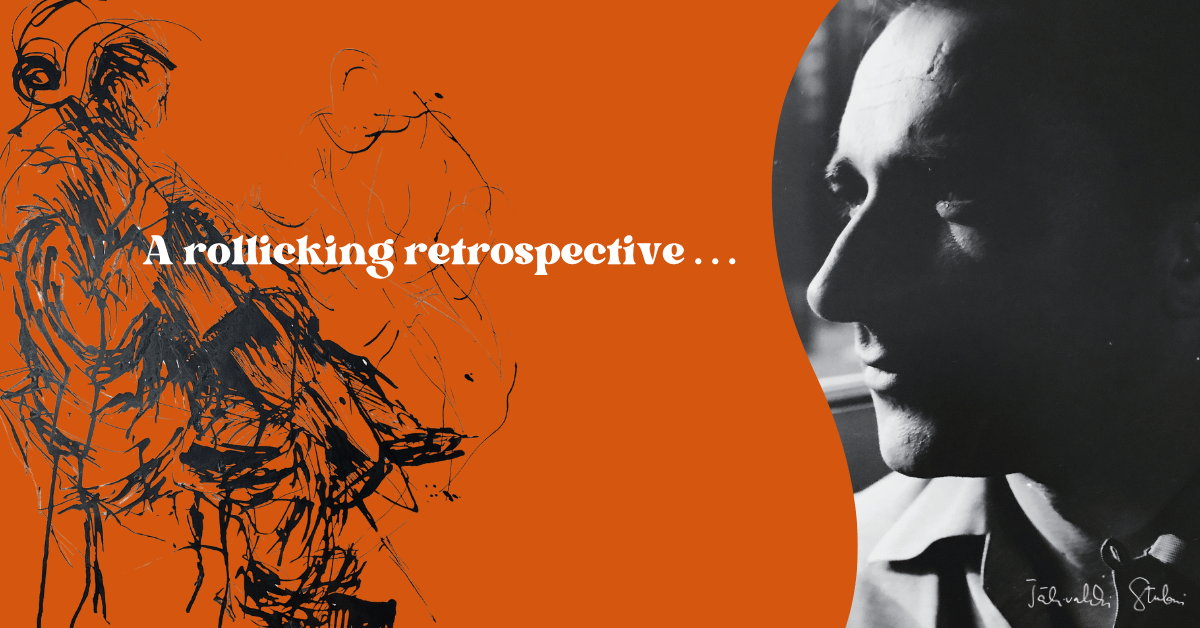
Prolific artist helped design, draw, and develop many of the most well-known images of the 20th Century
WASHINGTON, DC, UNITED STATES, May 22, 2026 /EINPresswire.com/ — One hundred years ago today, one of the most creative and prolific graphic designers of the 20th Century was born and went on to help produce hundreds of the most iconic images for film, Broadway, books, and record jackets – images recognized by millions in countries around the world. Yet his name is little known, interested as he was primarily in artistic creation and exciting new projects rather than retrospection and acknowledgment. A new, year-long centennial celebration aims to remedy that situation and throw long-overdue light onto one of the most intensively innovative and creatively inexhaustible graphic artists of the last 100 years.
Tālivaldis Stubis was born on May 22, 1926 in Riga, Latvia, whose rich tradition of colorful, playful, and ancient pagan art influenced him from the very beginning. Starting at an early age, he began rendering images of family members, friends, and common household scenes, and showed an unusual ability to catch the moment of a particular scene or the personality of a subject with a few deft strokes. He was rarely without a pad and pen and produced a constant stream of sketches. As he grew older, he was most inspired by the works of Picasso and Chagall and began creating works in oils, water colors, and clay. When only a teenager, World War II arrived and in the turmoil his family was swept up with thousands of others and put into displaced persons camps in Germany. As a young man, he was assigned the task of digging victims out of collapsed buildings following air raids. In between bombings and the boredom of day-to-day life, he sketched scenes from inside the camp and often sneaked out to capture the bustling street activity in nearby Leipzig. With only the meager resources he could scrape together, he designed and painted makeshift stage sets so that the refugees could mount original plays they themselves wrote and performed to distract them from their situation. After the war, Stubis wanted to leave but could not return to Latvia since the Soviet Union had invaded it, and so he stayed in Germany where he studied architecture at the University of Stuttgart. In 1950, he arrived in America with two dollars in his pocket. He continued his art studies at the University of Wisconsin and then moved to New York City, where he lived in cheap five-story walkups and supported himself by painting ties in a sweatshop, all the while applying for positions at art agencies around the city. He was soon hired and earned senior creative positions at a series of important design studios specializing first in Broadway and, later, movie posters.
Among the artist’s most memorable images was the illustration for the famed Broadway musical and movie, “Funny Girl,” which featured the image of an upside-down girl on roller skates whose body spells out the title, but he worked on literally hundreds of other now-legendary posters for stage and screen. His other Broadway works included Lerner and Loewe’s “Camelot,” Stephen Sondheim’s “Anyone Can Whistle” and “Gypsy,” Tennessee Williams’ “Night of the Iguana,” Neil Simon’s “Promises, Promises,” “The Fun Couple,” starring Jane Fonda, Bradford Dilman, and Dyan Cannon, and Rodgers & Hammerstein’s “Flower Drum Song.”
As senior art director for several major movie advertising agencies, he worked on many of the best-known movie poster campaigns of the 20th century, including (just to list a few) Stanley Kubrick’s “A Clockwork Orange” and “Barry Lyndon,” “Deliverance,” “The Sting,” “The Exorcist,” “Day for Night,” “Cool Hand Luke,” “Night of the Iguana,” “Lady Sings the Blues,” “Airplane!,” “Elephant Man,” “Reds,” “Ordinary People,” “An Officer and a Gentleman,” “Witness,” “Star Trek,” and “Raiders of the Lost Ark.” A fuller listing will soon be published on www.TalivaldisStubis.com, an upcoming website and online museum dedicated to the artist.
Stubis was prolific in coming up with and developing creative concepts, and he was known in the industry for his ability to read a script and come up with a dozen ideas in an hour. His concepts were often finished by leading illustrators, but he also used his own drawing talent in innovative ways and often created trends, for example, once under time constraints simply writing the title across the poster image, and another time tearing and repasting an image for dramatic effect, which led to a kind of run on “handwritten” titles and “torn” movie posters.
On most nights and weekends, Stubis worked at his “other job” as a popular book illustrator hired by major publishers such as Harper & Row, Scholastic, Lothrop, Lee & Shepard, Parents Magazine, Crest, and Doubleday. Over the course of his long career, he illustrated twenty-four books, creating a cover for the paperback version of Erich Maria Remarque’s “All Quiet On the Western Front,” and working with such illustrious authors as Otto Friedrich on “Sir Alva and the Wicked Wizard,” poet and editor Lillian Moore on “Sam’s Place,” and husband-and-wife team Rose Wyler and Gerald Ames, who turned out dozens of books in the 1950s, 60s and 70s such as “Prove it!” to excite children’s interest in science. His books won numerous awards and in 1962 “A Pocketful of Seasons” was named one of the New York Times’ “100 Best Books of the Year.” His books, especially his children’s book, were translated and sold in foreign countries around the world. The Japanese were particularly fond of his work, which combined simplicity and elegance of line. In 1954, Stubis married ballet dancer Patricia Ann Thomas and together they collaborated on “Sandwichery,” a cookbook for children. Of all the books he illustrated, Stubis’ favorite was “Don’t Tell the Scarecrow,” a book of haikus by the great classical Japanese masters, which Stubis complemented with what looked like gauzy, impressionistic watercolors but were actually created through the skillful use of magic markers and wet paper.
In addition to the record jackets for the theatrical and movie posters he designed, Stubis was also commissioned to create the covers for several series of classical music LPs, including those for The Haydn Society and Westminster Records.
Finally, there is his almost completely unknown body of fine art works, many of which were discovered by his family after his death. He especially loved drawing musicians and their instruments, dancers, nudes, small landscapes, abstracts, and sketches of street scenes and ordinary people – all of which he limned with clean, elegant and economical lines. Those who know them consider them among his finest achievements.
Incomprehensibly, to his admirers, Stubis never promoted himself or his work. “My father was not just one of the most original people I ever knew, but the least interested in his past accomplishments,” said Mark Stubis, who is launching the centennial project with the help of Tālivaldis’ granddaughter, artist, gallery director, and museum specialist Halley Stubis. “He didn’t seem to mind that throughout his career, a number of people claimed credit for work he had done or significantly contributed to. One time, a famous producer erased my father’s name from a movie poster and added his own. Another time, a young artist came by the agency and asked if my father would look at his work. Having a few minutes, my father agreed. The young man opened up his portfolio and proceeded to show several samples of work that my dad had actually created. My father gently asked if he had done them himself and the man affirmed that he had. Instead of exposing the fib, my father was amused, wryly complimented him on creating such good work, and showed him out. The truth is that he was passionate about whatever he was working on next and rarely looked back – so much so that he never even kept copies of the famous works in which he had a hand. If we wanted a popular poster, we had to buy it ourselves!”
In his personal life, Stubis loved art, languages, exotic foods, music, and history. One could ask him about an obscure medieval battle and he could not only relate the key facts and figures involved, but what led up to it, and how it set the stage for later events. Stubis was a fanatic about the game Royalty, a word game involving cards, coming up with the most unexpected and arcane words that often sent his opponents scrambling to the Oxford English Dictionary, where they conceded defeat and grudgingly learned a new word. Stubis died at his Bayside, New York home on November 8, 2009 at the age of 83.
The Tālivaldis Stubis Centennial Celebration will include information and stories about the artist, a new website and online museum, 100 engaging and informative social posts and art samples to mark the hundred years since his birth, and a traveling exhibit/presentation of his works and life. Those interested in hosting an event in their area may write to BooksArtsAndMusic@gmail.com.
For more information on the Tālivaldis Stubis Centennial Celebration and Online Museum, please visit:
Website: www.TalivaldisStubis.com (coming soon)
Facebook: https://www.facebook.com/profile.php?id=61590107948581
Instagram: @TalivaldisStubis
Mark
Books Arts and Music
+ +1 202-380-8964
email us here
Legal Disclaimer:
EIN Presswire provides this news content “as is” without warranty of any kind. We do not accept any responsibility or liability
for the accuracy, content, images, videos, licenses, completeness, legality, or reliability of the information contained in this
article. If you have any complaints or copyright issues related to this article, kindly contact the author above.

Media gallery