The Question Every Operations Leader Is Already Asking
At some point in the last year, you have looked at your contact center budget and felt the tension directly. Salaries, benefits, overtime, facilities, management overhead — the fully loaded cost of running an in-house contact center team keeps climbing. And yet every time a cost reduction idea surfaces, someone in the room raises the same concern: what happens to customer experience if we cut?
It is a fair question. Leaders who have seen offshore outsourcing done badly know what the failure looks like. Heavy accents that distract customers from the conversation. Agents reading scripts without understanding context. First call resolution rates that drop. Complaints that make it to social media. The cost savings evaporate quickly when customer churn picks up or your support escalations start overwhelming the internal team you were trying to protect.
But the assumption buried in that concern — that cost reduction and quality protection cannot coexist — is worth examining carefully. Because in most cases, the real variable is not whether you offshore. It is how the system around the offshore team is built.
This article walks through why contact center costs stay high even when leaders try to control them, what a modern outsourcing structure actually looks like for a 10 to 100 agent SMB, and a practical framework you can use to evaluate whether your current approach is generating unnecessary expense without delivering the quality protection you are paying for.
Why Costs Stay High Even When You Are Trying to Control Them
The internal contact center cost problem is rarely a single line item. Leaders who look at agent salaries alone are typically missing 40 to 60 percent of the real cost. Benefits, payroll taxes, facilities, equipment, supervision overhead, HR burden, recruiting and onboarding costs for a function with chronic turnover — these add up to a fully loaded per-agent number that most finance teams have never formally calculated.
Beyond the cost structure, there is a flexibility problem. Internal teams are difficult to scale with demand. When call volumes spike in retail during Q4, or utilities face weather-related surge events, or telecom companies run a promotion, the options are limited: pay overtime, hire temporary workers who are not yet trained, or let customers wait. None of these options is clean, and all of them add cost or damage experience.
The third layer is visibility. Most in-house QA programs sample between two and five percent of calls. Supervisors are reviewing a tiny slice of interactions and drawing conclusions about agent performance, compliance adherence, and script execution from an incomplete picture. Problems that show up in customer satisfaction data often have roots in agent behavior patterns that no one has seen because no one has been able to look at 100 percent of the calls.
These three dynamics — inflated fully loaded costs, inflexible capacity, and limited QA coverage — are the system-level reasons contact center costs stay high without delivering the quality visibility leaders expect. Addressing one without the others produces partial results at best.
What a Modern Outsourcing System Actually Looks Like
A well-structured outsourcing model for a 10 to 100 agent SMB does not look like a pool of cheap seats in a distant country handling your calls without visibility or control. That model exists and it produces the failure patterns described above. What a structured model looks like is different.
It starts with Philippine-based teams selected for strong English communication and customer handling skills, paired with accent neutralization technology that reduces the perceived offshore friction that has historically made customers less receptive to offshore interactions. The conversation stays focused on resolution rather than accent, which is the outcome both the customer and the operations leader want.
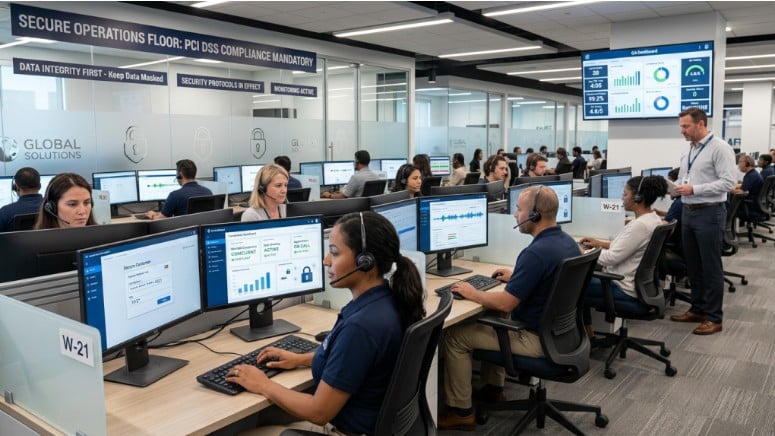
It layers AI-driven quality assurance across 100 percent of calls — not a sample. Every interaction is reviewed, patterns are surfaced, coaching opportunities are identified, and compliance signals are flagged before they become complaints or escalations. The operations leader gains more visibility into what is actually happening on every customer interaction than most in-house QA programs can produce at any price.
The commercial structure is a single fully loaded hourly rate covering all taxes, benefits, and employment obligations for the offshore team. There is no software license, no per-seat technology fee, no hidden staffing markup. One rate, full-service team, reporting that goes to your operations and finance leadership in a format they can read without a technical background.
A Framework for Evaluating Your Current Cost-vs-Quality Position
Before making any decision about outsourcing, restructuring, or vendor changes, it helps to have a clear picture of where your current model is actually generating cost without generating quality protection. The following five-element framework gives operations leaders a structured way to assess that.
1. Fully Loaded Cost Per Agent Most teams know their base salary line. Few have calculated the actual fully loaded cost per agent including benefits, payroll taxes, facilities allocation, equipment, training, and management overhead per agent supervised. Until this number exists, cost comparisons with any outsourcing model are not apples to apples. The question to ask: what does it actually cost us to have one agent available to take a call?
2. QA Coverage Rate What percentage of calls does your current QA program review? If the answer is under 10 percent, you have a visibility gap — not a quality program. The question to ask: are the coaching decisions and compliance reviews we make based on a representative sample, or are we working from a small slice of interactions that may not reflect what is actually happening?
3. Capacity Flexibility How does your current team handle a 30 percent spike in volume? What is the real cost — overtime, temp labor, queue abandonment — when demand exceeds your baseline staffing? A model that cannot flex without significant cost or quality impact has a structural vulnerability that compounds over time.
4. Process Documentation Which of your customer-facing processes are fully documented in black-and-white, step-by-step procedures that a trained agent could follow without tribal knowledge? This is the single most important readiness indicator for outsourcing. Processes that depend on institutional knowledge or judgment calls do not transfer cleanly offshore — or to any new agent, regardless of geography.
5. Management Overhead Per Agent How much of your supervisors’ and operations managers’ time is consumed by contact center oversight — scheduling, coaching, QA review, escalation handling, vendor coordination? In many SMBs, this overhead is invisible in the budget but significant in practice. A well-structured outsourcing model is designed to reduce this burden, not add to it. The question to ask: if we outsourced this function, would our internal management load go up or down?
How This Plays Out in Practice
Consider a mid-size retail operation running 35 in-house customer service agents across two locations, with a supervisor-to-agent ratio that requires four full-time supervisors. Their peak season doubles inbound volume, and their current response is mandatory overtime plus two rounds of seasonal hiring each year. QA coverage sits at three percent of calls. They have never calculated their fully loaded cost per agent but estimate salaries at roughly $38,000 annually per agent.
When they run the full calculation — benefits, taxes, facilities, supervision overhead, recruiting, seasonal hiring costs — the actual fully loaded cost per available agent is meaningfully higher than the salary line suggests. Seasonal flexibility adds further cost that is not visible in the base budget.
An outsourcing structure built around well-documented, high-volume processes — order status, return initiation, billing questions, basic troubleshooting — with AI QA on 100 percent of calls and accent neutralization could, for organizations with the right process foundation, reduce cost per contact while giving leadership more visibility into agent performance than their current three percent QA sample provides. The seasonal flexibility issue becomes a rate and volume conversation rather than a hiring and training operation.
The trade-off is real: this requires process documentation, a structured transition period, and a clear-eyed view of which processes are actually simple enough to transfer. Retailers whose customer interactions are exception-heavy, highly contextual, or dependent on deep product knowledge need to sequence the transition carefully, starting with the highest-volume, clearest processes before moving to more complex interactions.
Now consider a regional telecom company running 60 agents handling tier one technical support. Their HelpDesk tickets follow a consistent troubleshooting flow for the top 15 issue types, which account for roughly 70 percent of volume. Their internal team spends significant time on these repeatable tickets while also being the escalation point for complex issues that genuinely require deeper expertise.
A tiered model — offshore team handling the documented 70 percent, internal team focused on escalations and complex cases — can restructure the cost and management load significantly. The offshore team handles volume. The internal team handles judgment. Both groups do the work they are best positioned to do.
What to Do Next
The cost-vs-quality tension in contact center operations is real, but it is not fixed. The leaders who resolve it most cleanly are the ones who stop treating it as a binary choice and start building the structural conditions — documented processes, full QA coverage, transparent offshore delivery, flexible capacity — that make cost reduction and quality protection compatible goals.
If you want to understand whether your current contact center model has addressable cost and visibility gaps, a compatibility session with Optimize CEC is a practical starting point. The conversation focuses on your actual volumes, processes, and cost structure — not a generic pitch — and can help you identify where a structured outsourcing model might generate better outcomes than your current approach, and where it might not be the right fit yet.
Schedule a compatibility session at https://optimizecec.com/contact-center-solutions/
Any claims in this article are based on previous experiences with clients and differ from client to client. Optimize CEC cannot make a guarantee on results because they depend on factors including internal processes, organizational readiness, and execution quality.
Optimize CEC
7000 Stonewood Dr.
Ste. 150A
Wexford
PA
15090
United States